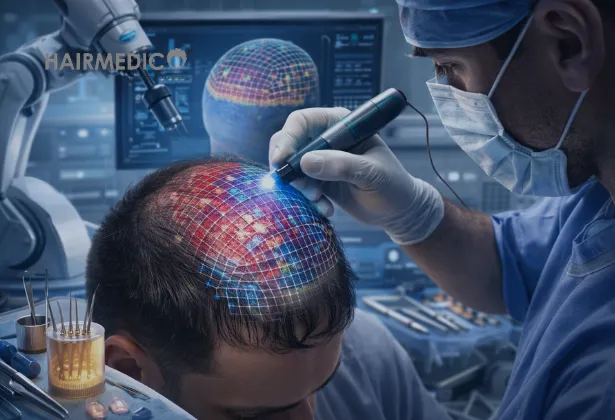
3D Scalp Mapping is not a decorative visual element, a software demonstration, or a marketing tool designed to impress patients before surgery. It is a medical planning discipline that fundamentally redefines how hair transplantation should be approached in modern practice. In my surgical philosophy, hair restoration is not about filling empty areas with grafts, but about designing a living structure that remains natural as the patient ages. This is only possible when the scalp is understood as a three-dimensional anatomical organ rather than a flat surface.
Traditional hair transplant planning relies mainly on two-dimensional photographs, visual assessments, and approximate density calculations. While experience can compensate for certain limitations, it cannot replace structured analysis. The scalp has curvature, depth, variations in skin thickness, vascular differences, and growth directions that change from zone to zone. 3D Scalp Mapping allows all these parameters to be evaluated simultaneously, transforming hair transplantation from an empirical estimation into medical architecture.
The scalp is composed of multiple layers that directly influence surgical outcomes. Skin thickness varies between the frontal hairline, mid-scalp, vertex, and donor area. Blood supply is not uniform, and scalp elasticity depends on age, genetics, and prior surgeries. Ignoring these factors can result in poor growth, artificial angles, or long-term aesthetic imbalance, even when implantation is technically correct.
3D Scalp Mapping enables the surgeon to analyze scalp topography in depth. Convex areas reflect light differently than flatter zones, meaning the same density can be perceived differently depending on location. Mapping also reveals subtle relief variations that affect hair orientation and layering. By understanding these three-dimensional characteristics, the surgeon creates implantation patterns that respect both anatomy and visual perception. The result looks natural not only in photographs, but in real life, under any lighting condition.
3D Scalp Mapping is not a single scan or an automated output. It is a structured planning process fully led by the surgeon. It begins with a detailed evaluation of hair characteristics, including shaft diameter, follicular unit composition, hair shape, and the contrast between hair and scalp. These elements determine coverage power and influence density distribution.
The next stage involves mapping natural growth direction and exit angles. Hair never grows vertically; it follows curved, zone-specific vectors that must be respected to avoid an artificial appearance. Finally, donor capacity is analyzed not as a single number, but as a spatial reserve distributed across safe zones. This approach allows calculation not only of how many grafts can be safely extracted today, but also how many should be preserved for potential future needs.
Two-dimensional planning treats the scalp like a flat canvas. It prioritizes surface symmetry and immediate visual impact, often at the expense of biological sustainability. While it may produce acceptable short-term results in simple cases, it fails in complex situations such as diffuse thinning, vertex reconstruction, corrective surgeries, or young patients with progressive hair loss.
Hair loss is dynamic. A transplant that appears dense and balanced at twelve months may look incoherent or artificial five or ten years later if future progression was not considered. 3D Scalp Mapping integrates long-term progression into surgical planning, enabling results that remain coherent even as surrounding native hair continues to thin. This forward-looking vision is essential in ethical hair restoration.
The hairline is the most visible and irreversible element of hair transplantation. A poorly designed hairline cannot be hidden and is extremely difficult to correct. 3D Scalp Mapping elevates hairline design from aesthetic intuition to anatomical precision. Facial proportions, forehead curvature, temporal recession patterns, and scalp convexity are analyzed together.
A natural hairline is never perfectly straight or uniformly dense. It features micro-irregularities, gradual density transitions, and subtle depth variations. Mapping allows these characteristics to be created intentionally rather than by chance. It also helps identify areas where implantation should be conservative, reducing the risk of future exposure as alopecia progresses. This conservative, surgeon-led philosophy is central to clinics such as <a href="https://hairmedico.com">Hairmedico</a>, where long-term naturalness is prioritized over immediate density.
The donor area is a finite biological resource. Once extracted, follicles cannot be replaced. One of the most common long-term complications in hair transplantation is donor depletion caused by aggressive extraction strategies focused solely on graft numbers. 3D Scalp Mapping provides a detailed spatial understanding of donor reserves, enabling balanced extraction that preserves aesthetics and future options.
Rather than treating the donor area as homogeneous, mapping reveals variations in density, caliber, and scalp elasticity. This allows strategic harvesting that minimizes visible thinning and reduces scarring risk. When combined with advanced techniques such as the <a href="https://hairmedico.com/sapphire-fue">Sapphire FUE hair transplant</a>, donor management becomes even more precise, with controlled channel creation and reduced tissue trauma.
3D Scalp Mapping integrates multiple clinical parameters into a single surgical plan.
| Parameter | Clinical Importance |
|---|---|
| Scalp curvature | Influences density perception and light reflection |
| Hair exit angle | Determines natural growth direction |
| Hair shaft diameter | Affects coverage efficiency |
| Follicular unit composition | Guides implantation strategy |
| Donor density distribution | Prevents overharvesting |
| Vascular mapping | Improves graft survival |
| Scalp elasticity | Reduces trauma and scarring |
The combined analysis of these variables enables a transition from approximation to controlled surgical design.
Graft survival depends directly on implantation depth, angle precision, blood supply, and tissue handling. 3D Scalp Mapping optimizes all these factors. Grafts implanted too deep, too shallow, or at incorrect angles show lower growth rates and inferior aesthetic quality. Mapping ensures each graft is placed in an optimal biological environment.
Respecting vascular zones also reduces postoperative inflammation and accelerates healing. Patients experience less shock loss, more uniform regrowth, and smoother recovery. Clinically, this translates into greater predictability and fewer corrective interventions.
One of the most underestimated benefits of 3D Scalp Mapping is its impact on patient communication. Many dissatisfactions after hair transplantation arise from unrealistic expectations rather than technical failure. Mapping allows the surgeon to explain the surgical plan visually and logically, demonstrating why certain areas are prioritized while others are deliberately preserved.
This transparency supports truly informed consent. Patients better understand achievable outcomes, donor limitations, and the long-term strategy. Trust is built not through promises, but through clarity and education.
Technology does not replace surgical judgment. 3D Scalp Mapping is a decision-support tool, not an autonomous system. When planning is delegated to non-medical staff or used purely for marketing purposes, its value is lost. Clinical examination, tactile assessment of scalp elasticity, and individualized understanding of hair loss progression remain indispensable.
A responsible surgeon integrates digital data with experience and ethical reasoning. The success of mapping depends entirely on who uses it and the decisions they make.
Conventional planning often focuses on immediate density and visual symmetry. While it may satisfy short-term expectations, it frequently leads to long-term problems such as donor exhaustion, artificial density transitions, and limited corrective options. 3D Scalp Mapping reorients strategy toward sustainability, balance, and biological respect.
Clinics adopting this methodology typically perform fewer procedures, but with higher precision. The focus shifts from volume to value, from quantity to quality. For patients seeking natural, age-appropriate results, this distinction is critical.
Hair transplantation does not stop aging. Hairlines mature, facial proportions change, and density perception evolves. A transplant that looks impressive at one year may appear artificial ten years later if aging was not considered during planning. 3D Scalp Mapping integrates these factors to ensure transplanted hair remains harmonious over time.
This approach is particularly important for younger patients. Aggressive lowering of the hairline at an early age often creates artificial contrast later. Ethical hair restoration prioritizes longevity over immediate impact.
The true value of 3D Scalp Mapping becomes evident when analyzing real clinical outcomes. Consistent hair direction, balanced density, and preserved donor areas are best assessed through documented cases. These principles are clearly demonstrated in <a href="https://hairmedico.com/before-after">before and after hair transplant results</a>, where planning quality directly reflects the naturalness of the outcome.
Ethics in hair transplantation are inseparable from planning. Promising unrealistic results, ignoring donor limitations, or prioritizing commercial interests over patient welfare leads to irreversible harm. 3D Scalp Mapping supports ethical practice by making limitations visible and measurable. It allows surgeons to plan conservatively, decline when necessary, and protect patients from future regret.
Ethical hair restoration does not aim for maximum density, but for the most appropriate result for each individual.
As technology advances, hair transplantation will continue to evolve toward greater precision and personalization. Predictive models and advanced imaging will refine planning tools, but the fundamental principle remains unchanged: success depends on respecting human biology. 3D Scalp Mapping represents a decisive step in this evolution, uniting art and science through structured analysis.
Clinics that adopt this approach are defining the future standard of care in hair restoration.
3D Scalp Mapping is neither an option nor an add-on. It is a structural shift in how hair transplantation is planned and performed. By considering the scalp as a three-dimensional anatomical organ, surgeons can create natural, safe, and lifelong sustainable results. In my surgical philosophy, mapping is a responsibility, not a luxury. It reflects a commitment to precision, ethics, and long-term patient satisfaction.

 FR
FR
 DE
DE
 RU
RU
 ES
ES
 PL
PL
 PT
PT
 IT
IT
 CS
CS
 AR
AR
 TR
TR
 Free Hair Analysis
 Whatsapp