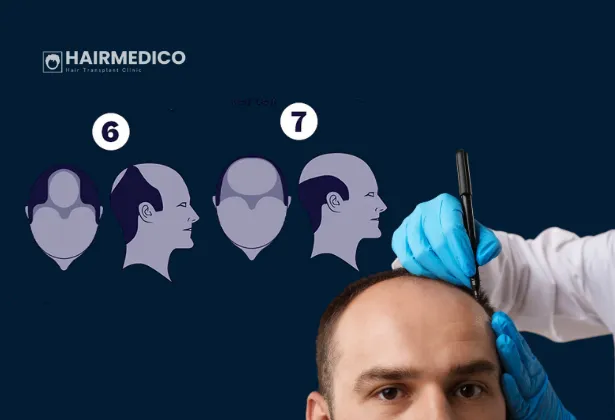
As a hair transplant surgeon with over 17 years of experience, one of the most common and complex questions I receive is: “Can Norwood 6 or 7 patients achieve successful hair transplant results?” The answer is yes—but only when the procedure is approached with precision, long-term planning, and a deep understanding of donor management and aesthetic design. Severe hair loss cases are not routine procedures; they require a strategic, surgical mindset combined with artistic execution.
The Norwood scale is the most widely used classification system for male pattern baldness. Patients categorized as Norwood 6 or 7 present with extensive hair loss, where the frontal, mid-scalp, and crown areas are largely devoid of hair. The remaining hair is typically limited to a horseshoe-shaped donor zone at the back and sides of the scalp.
In these advanced stages, the challenge is not just covering bald areas but doing so with limited donor resources. Unlike early-stage patients, where density can be maximized, Norwood 6–7 patients require prioritization and intelligent distribution of grafts.
Yes, hair transplantation is possible for Norwood 6 and 7 patients. However, the goal is not to recreate the hair density of adolescence but to design a natural, age-appropriate, and sustainable result. Success depends on three critical pillars: donor capacity, surgical planning, and patient expectations.
At Hairmedico, we approach such cases with a highly individualized strategy, ensuring that every graft is used with maximum efficiency. You can explore more about our surgical philosophy and approach here: <a href="https://hairmedico.com/hair-transplant">hair transplant procedures</a>.
The donor area is the foundation of any hair transplant, but in Norwood 6–7 patients, it becomes the limiting factor. A typical donor area may provide between 5,000 to 7,000 grafts over multiple sessions, depending on hair characteristics such as thickness, density, and scalp elasticity.
Overharvesting is one of the most critical mistakes in such cases. Once the donor area is depleted, no further surgical options remain. Therefore, preserving donor integrity while achieving visible improvement is the cornerstone of advanced hair restoration.
In severe hair loss cases, we do not aim to cover every square centimeter of the scalp. Instead, we focus on visual impact. The frontal hairline and mid-scalp are prioritized because they define the patient’s appearance. The crown, which consumes a large number of grafts, is often addressed in later sessions or left with lighter density.
This approach ensures that the patient achieves a natural look rather than an artificial or overextended result. The art of hair transplantation lies not in how many grafts are implanted, but in how intelligently they are distributed.
Designing a hairline for Norwood 6–7 patients requires restraint and experience. A low, aggressive hairline may look appealing initially but will compromise donor reserves and lead to unnatural outcomes over time.
Instead, we design a mature, age-appropriate hairline that blends seamlessly with the patient’s facial structure. This is where surgical expertise meets artistry. To understand the importance of surgeon-led planning, you can learn more about Dr. Arslan Musbeh’s approach here: <a href="https://hairmedico.com/dr-arslan-musbeh">Dr. Arslan Musbeh</a>.
One of the biggest misconceptions is that higher graft numbers automatically result in better outcomes. In reality, density must be balanced with coverage. For Norwood 6–7 patients, spreading grafts too thin can lead to a “see-through” effect, while over-concentrating them in one area can leave other regions untreated.
The optimal strategy is to create an illusion of density through proper angulation, direction, and placement of grafts. This requires surgical precision and experience, especially in large-scale procedures.
Most Norwood 6–7 cases cannot be completed in a single session. A staged approach is often necessary. The first session focuses on the frontal zone, delivering immediate visual improvement. Subsequent sessions may address the mid-scalp and crown, depending on donor availability and patient goals.
Spacing sessions allows the donor area to recover and ensures that each stage is executed with maximum precision.
In some cases, additional donor sources such as beard or body hair may be considered. These grafts can be used to increase overall coverage, particularly in the crown or mid-scalp. However, they must be used selectively, as their texture differs from scalp hair.
Medical treatments such as Finasteride or Minoxidil may also be recommended to stabilize existing hair and enhance overall results. Hair transplantation should always be part of a comprehensive treatment plan rather than a standalone solution.
Managing expectations is critical in advanced hair loss cases. Patients must understand that the goal is improvement, not perfection. A well-executed transplant can dramatically enhance appearance, restore confidence, and create a natural frame for the face.
However, expecting full density across the entire scalp is not realistic with limited donor resources. Honest communication between surgeon and patient is essential for achieving satisfaction.
Norwood 6–7 cases are among the most technically demanding procedures in hair restoration. They require not only surgical skill but also long-term vision. An inexperienced approach can lead to irreversible mistakes, particularly in donor management and hairline design.
At Hairmedico, our one-patient-per-day model allows us to dedicate full attention to each case, ensuring meticulous planning and execution. This level of focus is particularly crucial in complex cases.
Hair transplant costs for Norwood 6–7 patients are typically higher due to the number of grafts required and the potential need for multiple sessions. However, cost should never be the primary deciding factor. Choosing a clinic based on price alone often leads to suboptimal results and the need for corrective procedures.
For a detailed breakdown of pricing and packages, you can visit: <a href="https://hairmedico.com/price">hair transplant cost</a>.
Hair transplantation is not a one-time event; it is a lifelong investment. Especially in advanced cases, planning must consider future hair loss progression. A well-designed transplant should age naturally with the patient, maintaining a balanced and harmonious appearance over time.
So, can Norwood 6 or 7 patients get a hair transplant? The answer is yes—but success depends on expertise, strategy, and realistic expectations. When performed correctly, even the most advanced hair loss cases can achieve transformative, natural-looking results.
As a surgeon, my philosophy is simple: every graft is valuable, every decision matters, and every patient deserves a personalized approach. With the right planning and execution, Norwood 6–7 patients can regain not only their hair but also their confidence.
No, full coverage with high density is not usually possible. The goal is to create a natural and balanced appearance.
Typically between 4,000 to 7,000 grafts, depending on donor capacity and treatment plan.
In most cases, no. Multiple sessions are required for optimal results.
Yes, beard hair can be used as a supplementary donor source in selected cases.
Transplanted hair is permanent, but existing hair may continue to thin over time.
About the Author
Dr. Arslan Musbeh is an internationally recognized hair transplant surgeon in Turkey and the founder of Hairmedico. With over 17 years of experience in FUE, Sapphire FUE, and DHI techniques, he is known for delivering natural, long-lasting results through a highly personalized, one-patient-per-day approach.

 FR
FR
 DE
DE
 RU
RU
 ES
ES
 PL
PL
 PT
PT
 IT
IT
 CS
CS
 AR
AR
 TR
TR
 Free Hair Analysis
 Whatsapp