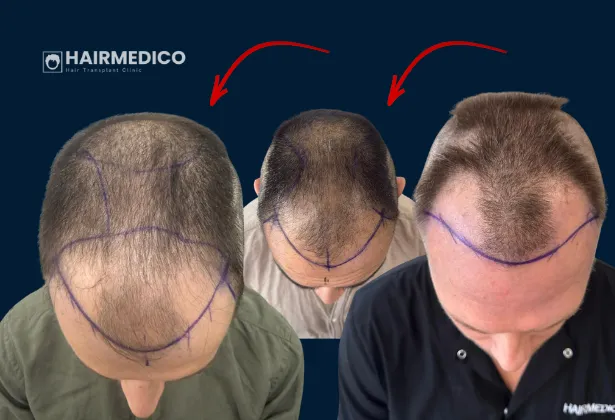
Hairline design is one of the most misunderstood aspects of hair transplant surgery. Many patients assume that the ideal hairline should be perfectly symmetrical—balanced equally on both sides of the face. At first glance, this seems logical. Symmetry is often associated with beauty and harmony.
However, from a biological and surgical perspective, strict symmetry is often a mistake.
Natural hairlines are rarely perfectly symmetrical. In fact, slight irregularities are what make them appear natural. When surgeons attempt to create mathematically perfect hairlines, the result often looks artificial—especially as the transplanted hair grows and integrates with native follicles.
Modern hair transplant surgery recognizes that the hairline is not simply a geometric line across the forehead. It is a biologically guided transition zone between the face and the scalp, influenced by follicular orientation, density gradients, vascular patterns, and long-term hair loss progression.
Understanding the biology behind hairline design is essential for achieving results that look natural not only immediately after surgery, but also years later.
One of the most common misconceptions among patients is that a hairline can be drawn like a ruler across the forehead.
In reality, the hairline is a complex biological structure shaped by several factors:
Follicular grouping patterns
Hair shaft direction and angle
Micro-irregularities along the border
Gradual density transitions
Age-related positioning
The human eye is highly sensitive to unnatural patterns. Even small deviations from natural follicular distribution can make a transplanted hairline appear artificial.
This is why modern hair restoration emphasizes biological realism rather than geometric symmetry.
Advanced surgical planning in modern hair restoration focuses on respecting follicular biology, vascular safety, and natural growth patterns rather than forcing mathematical shapes onto the scalp.
👉 Learn more about modern surgical hair restoration principles here: https://hairmedico.com/hair-transplant
If you examine natural hairlines closely, you will notice that they almost always contain subtle asymmetries.
These asymmetries occur because hair growth is influenced by:
Genetic follicular distribution
Facial muscle dynamics
Scalp tension patterns
Local vascular variations
The left and right sides of the face are also rarely identical. Bone structure, eyebrow height, and forehead curvature all differ slightly.
A hairline that ignores these asymmetries often looks unnatural because it conflicts with the patient’s facial anatomy.
Experienced surgeons therefore design hairlines that complement the face rather than mirror it perfectly.
The goal is harmony, not mathematical symmetry.
A natural hairline is not straight or uniform. It contains what surgeons call micro-irregularities.
These include:
Subtle zig-zag transitions
Randomized follicular placement
Variable single-hair graft distribution
Irregular spacing along the frontal border
These irregularities serve an important visual function.
They break up artificial patterns.
When hairlines are created using evenly spaced grafts in straight rows, the result often resembles a “plug” pattern—even if modern follicular units are used.
In contrast, micro-irregularity mimics the randomness seen in natural hair growth.
This is why experienced surgeons design hairlines using artistic as well as surgical judgment.
The first few millimeters of the hairline are known as the transition zone.
In natural hairlines, this zone contains primarily:
Single-hair follicular units
Lower density
Fine caliber hairs
Behind this area, density gradually increases with:
Two-hair grafts
Three-hair grafts
Occasionally four-hair follicular units
This gradual transition is essential.
If multi-hair grafts are placed directly at the frontal edge, the hairline can appear harsh or unnatural.
Proper transition zone planning is one of the defining characteristics of high-quality hair transplant surgery.
Hairline naturalness is not determined by density alone.
Hair angle and direction play an equally critical role.
In the frontal hairline:
Hair exits the scalp at very acute angles
Follicles grow slightly forward
Lateral sections angle outward toward the temples
Incorrect angulation can create several problems:
Hair that stands upright unnaturally
Difficulty styling
Visible scalp due to incorrect light reflection
Achieving correct follicular angulation requires surgical precision and experience.
Even a few degrees of error can dramatically affect the final visual outcome.
Another common mistake in hairline design is placing the hairline too low.
While younger patients often request low hairlines, surgeons must consider long-term aesthetics.
Hairlines naturally mature with age.
Designing an overly aggressive hairline can lead to problems such as:
Unnatural appearance in later years
Excessive graft demand
Donor area depletion
A biologically appropriate hairline respects facial proportions and future hair loss patterns.
This requires careful surgical planning and long-term thinking.
The philosophy behind sustainable hairline design and long-term aesthetic planning is central to the surgical approach used by Dr. Arslan Musbeh.
👉 Learn more about his methodology here: https://hairmedico.com/dr-arslan-musbeh
Hairline design cannot be separated from overall density planning.
A strong hairline with weak density behind it creates a visual imbalance.
Conversely, a dense mid-scalp with a poorly defined hairline also appears unnatural.
Successful hair restoration requires coordinated planning of:
Hairline structure
Mid-scalp density
Crown management
Donor area preservation
This integrated approach ensures that the hairline remains natural as the patient ages.
Another factor often ignored in hairline design is vascular biology.
The frontal scalp has a delicate vascular network that supplies transplanted grafts with oxygen and nutrients.
If grafts are placed too densely or too aggressively, vascular compromise can occur.
This may lead to:
Reduced graft survival
Delayed growth
Patchy density
Respecting vascular capacity is essential for achieving predictable long-term results.
Biology always defines the limits of surgery.
Many patients assume that hairline work requires fewer grafts and therefore costs less.
In reality, hairline design is often the most technically demanding part of hair transplant surgery.
It requires:
Precise follicular selection
Microscopic graft placement
Meticulous angulation control
Artistic design judgment
For this reason, surgical planning and expertise—not simply graft numbers—determine the complexity of the procedure.
Hair transplant pricing therefore reflects surgical time, technique, and physician involvement rather than raw graft counts.
👉 You can review Hairmedico’s procedure-based pricing philosophy here: https://hairmedico.com/price
The hairline frames the face.
Even small changes can dramatically influence how a person appears.
A well-designed hairline can:
Restore facial balance
Improve perceived youthfulness
Increase patient confidence
However, poorly designed hairlines are difficult to correct and may require revision surgery.
This is why careful planning before surgery is critical.
Hairline design is not about drawing a straight line.
It is about understanding biology.
Natural hairlines contain:
Subtle asymmetry
Micro-irregularity
Gradual density transitions
Precise follicular angulation
When these biological principles are respected, transplanted hairlines become indistinguishable from natural ones.
When they are ignored, even technically successful surgeries can look artificial.
The best hair transplant results are therefore achieved when surgical precision is guided by biological understanding rather than geometric symmetry.
Hairline design is not mathematics.
It is biology combined with surgical artistry.

 FR
FR
 DE
DE
 RU
RU
 ES
ES
 PL
PL
 PT
PT
 IT
IT
 CS
CS
 AR
AR
 TR
TR
 Free Hair Analysis
 Whatsapp