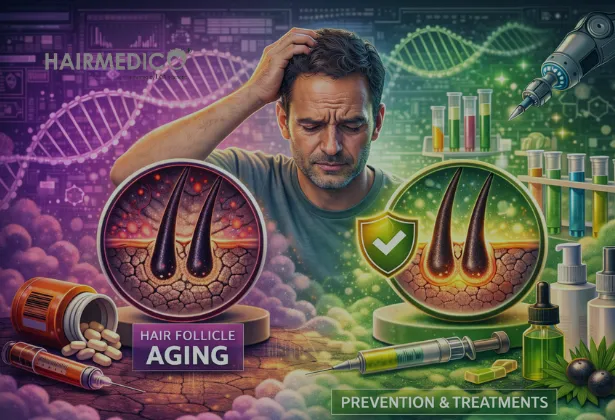
Hair aging is not a sudden event. It is a progressive, multi-layered biological process that begins silently years before visible thinning or hair loss appears. From a surgical and medical standpoint, understanding hair follicle aging is essential—not only for preventing hair loss, but for planning sustainable treatments, realistic hair restoration strategies, and long-term scalp health.
In clinical practice, one of the most common misconceptions is that hair loss is purely genetic and therefore unavoidable. Genetics certainly play a role, but follicular aging is influenced by a far wider network of biological, hormonal, inflammatory, and environmental mechanisms. Hair follicles age similarly to other mini-organs in the body: they lose regenerative capacity, vascular support weakens, stem cell signaling declines, and inflammatory burden increases.
This article examines hair follicle aging through a scientific and clinical lens, focusing on prevention, treatment, and what modern medicine truly understands today.
✓ Hair follicle aging is measurable
✓ It is partially preventable
✓ It is treatable—but not reversible
✓ Early intervention defines long-term outcomes
A hair follicle is not a static structure. It is a dynamic mini-organ with its own stem cell niche, vascular supply, immune interactions, and hormonal sensitivity. Each follicle cycles continuously through three main phases:
• Anagen (growth phase)
• Catagen (regression phase)
• Telogen (resting/shedding phase)
With aging, this cycle becomes progressively dysregulated.
Key age-related follicular changes include:
✓ Shortening of the anagen phase
✓ Prolongation of telogen
✓ Miniaturization of the follicle bulb
✓ Reduced melanocyte activity (graying)
✓ Decreased dermal papilla cell signaling
These changes do not occur overnight. They accumulate gradually, often beginning in the mid-20s, long before visible hair loss is recognized.
Hair follicle aging is driven by overlapping biological mechanisms rather than a single cause.
Certain follicles are genetically predisposed to androgen sensitivity, particularly to dihydrotestosterone (DHT). Over time, this sensitivity accelerates follicular miniaturization.
Androgens modulate follicle size, growth duration, and sebaceous activity. With age, hormonal signaling becomes less balanced, especially in genetically susceptible individuals.
Chronic low-grade inflammation around the follicle—often invisible clinically—plays a major role in accelerating follicular aging. This inflammation disrupts stem cell signaling and damages surrounding connective tissue.
Reactive oxygen species accumulate with age and environmental exposure (UV radiation, pollution, smoking). Oxidative damage directly impairs follicular stem cells.
Reduced scalp microcirculation limits oxygen and nutrient delivery, weakening follicle metabolism and regenerative capacity.
✓ Aging is cumulative
✓ Damage is often silent
✓ Early biological shifts matter most
Hair loss is a clinical outcome. Hair follicle aging is the biological process behind it.
A patient may have aging follicles without obvious hair loss, while another may show rapid thinning due to accelerated aging mechanisms. This distinction is critical in treatment planning.
| Aspect | Hair Follicle Aging | Hair Loss |
|---|---|---|
| Nature | Biological process | Clinical manifestation |
| Timeline | Gradual, long-term | Often noticeable later |
| Reversibility | No | Partially manageable |
| Prevention | Possible | Limited once advanced |
| Treatment Goal | Slow progression | Restore or camouflage |
Understanding this difference allows for proactive rather than reactive strategies.
Before density visibly decreases, subtle changes appear:
✓ Reduced hair shaft diameter
✓ Slower hair growth rate
✓ Increased shedding variability
✓ Loss of shine and elasticity
✓ Early graying in specific zones
Clinically, these signs often precede androgenetic alopecia by several years.
Prevention is the most powerful tool against hair follicle aging. Once a follicle is severely miniaturized, medicine can only manage—not restore—it.
A healthy scalp environment supports follicular longevity.
✓ Balanced scalp microbiome
✓ Controlled sebum production
✓ Reduced inflammatory triggers
✓ Proper pH maintenance
Targeted hormonal control—when medically appropriate—can slow genetically driven follicular aging.
✓ DHT pathway modulation
✓ Avoiding indiscriminate hormone use
✓ Individualized medical supervision
Reducing perifollicular inflammation preserves stem cell signaling.
✓ Evidence-based topical agents
✓ Lifestyle-related inflammation control
✓ Stress modulation
Antioxidant strategies protect follicular stem cells.
✓ UV protection
✓ Environmental exposure awareness
✓ Nutritional optimization
✓ Prevention works best early
✓ Timing is critical
✓ Consistency outweighs intensity
Medical therapy does not “rejuvenate” follicles, but it can significantly slow aging and prolong functional lifespan.
Certain medications stabilize follicular cycling and diameter.
✓ Improved anagen duration
✓ Reduced miniaturization velocity
✓ Better follicle retention
Autologous regenerative approaches aim to enhance follicular micro-environment.
✓ Growth factor signaling support
✓ Improved vascularization
✓ Temporary biological stimulation
Some non-invasive modalities support cellular metabolism.
✓ Mitochondrial activation
✓ Increased local circulation
✓ Adjunctive—not primary—role
Hair follicles reflect systemic health. Aging accelerates when systemic deficiencies or metabolic stressors exist.
Key contributors include:
✓ Iron imbalance
✓ Vitamin D deficiency
✓ Insulin resistance
✓ Thyroid dysfunction
Addressing these factors does not reverse aging but prevents unnecessary acceleration.
Hair transplantation does not stop follicular aging. It redistributes genetically resistant follicles.
This distinction is essential.
✓ Transplanted follicles still age
✓ Surrounding native hair continues aging
✓ Long-term planning is mandatory
From a surgical standpoint, ignoring follicular aging leads to unnatural outcomes over time. Ethical hair restoration requires:
✓ Conservative hairline design
✓ Donor preservation
✓ Future loss anticipation
The most successful hair outcomes are achieved when aging is anticipated, not reacted to.
A sustainable plan includes:
✓ Early prevention
✓ Medical stabilization
✓ Delayed surgical intervention when possible
✓ Ongoing scalp management
Short-term cosmetic thinking often results in long-term dissatisfaction.
Modern marketing often promises “follicle rejuvenation” or “hair reversal.” Scientifically, this is inaccurate.
✓ Aged follicles cannot be made young again
✓ Stem cell exhaustion is not reversible
✓ Treatments manage—not reset—biology
Honest medicine respects biological limits.
Hair follicle aging is inevitable—but its speed, severity, and clinical impact are highly modifiable.
From a medical and surgical standpoint, success lies in understanding biology early, intervening conservatively, and planning responsibly.
✓ Prevention is superior to correction
✓ Biology defines limits
✓ Ethics define quality
✓ Time defines outcomes
In my clinical philosophy, hair restoration is not about chasing density—it is about preserving identity, proportion, and long-term harmony.

 FR
FR
 DE
DE
 RU
RU
 ES
ES
 PL
PL
 PT
PT
 IT
IT
 CS
CS
 AR
AR
 TR
TR
 Free Hair Analysis
 Whatsapp